

Researcher: Hendrieta Ferieka
The system of Islamic Banks that apply Islamic principles and Conventional Banks has an important function in the national economic sector in terms of increasing the ability to finance. What distinguishes between Islamic Banks and Conventional Banks is in terms of the principles applied. Like the principle of profit sharing applied in Islamic Banks which of course will provide the values of togetherness and brotherhood.
The Islamic banking system in Indonesia in the last 10 years has developed significantly. The total assets of the Islamic banking industry have increased almost 12 times from IDR 37.73 trillion in 2007 to IDR 435.02 trillion in 2017. Financing channeled by Islamic banking as of December 2017 has reached IDR 291.18 trillion and at the same time, the collection of DPK (Dana Pihak Ketiga – Third Party Funds) reached IDR 341.70 trillion which reflects the increasing public trust to save and entrust the management of their funds in Islamic banks and the increasingly competitive profit sharing in Islamic banks.
Sharia banking has served people in all corners of Indonesia. Currently, there are 13 Islamic Commercial Banks, 21 Sharia Business Units, and 167 Islamic People’s Financing Banks with more than 2,500 office networks ready to serve the people of Indonesia spread across 34 provinces. Sharia banking services are also supported by more than 49,000 ATM Bersama networks, and 88,000 ATM Prima network units, to provide convenience for financial and banking transactions. This condition is expected to trigger enthusiasm to work and try even harder so that Islamic banking can contribute even more to the national economy.
The sharia system offered by Islamic banks includes justice, transparency, accountability, and mutual trust, and the operating system of Islamic banks is protected from all kinds of usury which is certainly not allowed in Islam. This is stated in the Al-Qurat Surah Al-Baqarah verse 275. The Islamic banking system is a non-ribawi banking system. Riba-free banking has begun to be applied in the Islamic world, but in practice, there have been many irregularities. This is due to (1) the absence of true knowledge and (2) the intention to deliberately deviate from Islamic rules by manipulating fiqh rules so that they appear explicitly to be lawful even though they are unlawful.
The Islamic banking system 4.0 must not only be correct and legal in formal fiqh muamalah, but free from usury, either express or implied. In this system, to be free from usury, both express and implied, Islamic banks must change their business model as money brokers to become money depository and credit service institutions. This is a completely different paradigm to the Islamic Banking System 1.0 and the ribawi banking system. The Islamic Banking System 4.0 is on the service-based side of depositors and the borrower’s side is based on accounts payable or credit.
The Islamic Banking System 4.0 must be completely free from usury, both in terms of fiqh (explicit) rules and in spirit eliminating the additional implied credit if implementing a new business model as follows:
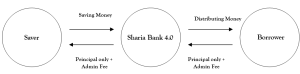
From the chart above, it can be seen that banks are institutions that are in the real sector, namely the general service sector, not the financial sector. Because basically, the Islamic financial system does not recognize any differences between the financial sector and the real sector. Simple systems are difficult to manipulate. The characteristics of an easy-to-understand system are: (1) Can be understood by ordinary people and from various backgrounds, educational strata and social classes, (2) Can be explained in one or two sentences, (3) Does not require an advanced understanding of mathematics, let alone requiring an understanding of probability calculations in the future.
The Islamic Banking System 4.0 is a service-based system, meaning that rewards are payments for work done by someone. Meanwhile, the ribawi banking system (loan interest > deposit interest) is a money trading system, not a service-based system. The Islamic Banking System 4.0 requires that the banking system only becomes a tool or intermediary for the development, and growth of goods and services, not the development of the financial system itself.
In the Islamic banking system 4.0, all economic sectors are the real sector. The costs incurred are service costs that are truly real and fulfill the principles of existence (mawjuud) and equality (musawwats). The cost of capital can be reduced to 0%, meaning that the borrower is not subject to any additional fees for the loan he gets, completely riba-free. If interest costs were one of the components in the costs included in commodity prices, there would be a reduction in costs. Overall the economy will experience efficiency.
In turn, there will be massive growth in the production of goods and services and make people work and not be lazy. The banking system which no longer provides certainty of interest in return for investment, makes people learn to invest and monitor the investment process. In turn, learning from investors about the business sector they enter and monitoring that investors exercise over their investment managers makes the investment safer. On the other hand, deposit interest which is above the inflation rate causes people to become lazy because the interest is enough to make them not work.
To meet the investment and working capital needs of companies and individual credit, the Islamic banking system 4.0 is more efficient and profitable for companies because capital costs are cheaper. Fulfillment of suitability of the Islamic banking system must be in two aspects: (1) Fulfillment of formal legal principles, (2) Fulfillment of the spirit in these principles. The prohibition of usury in Islamic finance was not explained by Rasulullah SAW in great detail during his lifetime, the characteristics of usury can be recognized easily. At this time usury was money trading which had a bad impact on the economy.
Although there is nothing wrong with murabaha, mudharabah and musyarakah schemes, when these schemes are implemented, their shape resembles money trading. So it is a kind of fiqh legal money trading. Of course, fiqh is not only a formal legalistic matter, fiqh must be able to capture the essence of the rules. Islamic banking products are not just camouflage or mimicry of the ribawi banking system. By using the Islamic banking system 4.0, this system is not only fiqh correct but also really carries out the essence of the prohibition of usury itself.

